
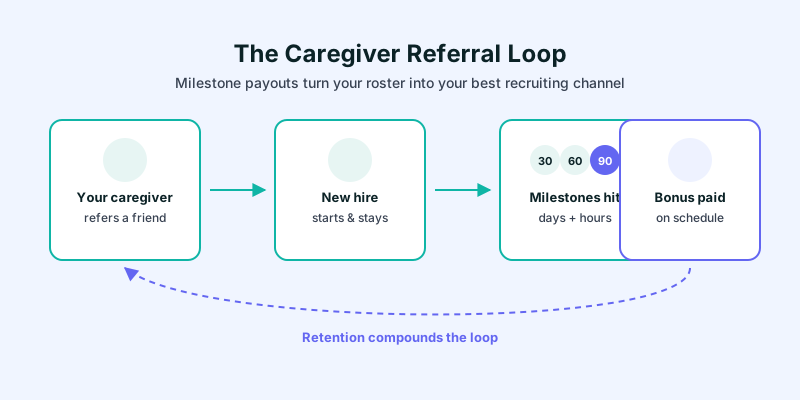
A caregiver referral program is a structured incentive that pays your existing caregivers for successfully referring new hires. It works when three things are true at once: the bonus pays out on retention milestones instead of a hire-day lump sum, the eligibility rules are written down before the first payout, and the program is promoted continuously instead of launched once and forgotten. Agencies that get all three right turn their current roster into their cheapest source of new caregivers — and, more importantly, their stickiest.
The median caregiver turnover rate dropped to 75% in 2024, the lowest level reported in the past five years, according to the Activated Insights Benchmarking Report (formerly Home Care Pulse). At that rate the average agency still replaces its entire caregiver roster roughly every 16 months (12 ÷ 0.75). Referrals attack both sides of that math: they are the cheapest channel to fill a seat, and referral hires are the least likely to leave it.
Key Takeaways
- Median caregiver turnover ran 75% in 2024 — a five-year low, and still replacement, not attraction, as the cost center
- Referred employees stay roughly 70% longer than non-referral hires across industries — and high-turnover industries see the biggest lift
- Real agencies pay $100–$400 per successful referral, almost always split across 30/60/90-day milestones
- Day-one lump sums remove the retention hook; milestone payouts are the whole point
- Track 90-day retention of referred vs. non-referred hires — participation rate alone will flatter the program
Why Referrals Beat Job Boards on Retention, Not Just Cost
Cross-industry analyses consistently find that referred employees outlast everyone else. Industry aggregations of referral program data report referred hires staying about 70% longer than non-referral hires, with 45% still on the job after four years versus 25% of job-board hires. The mechanism is intuitive: a caregiver will not stake their reputation with a friend on a workplace they expect to quit.
The detail that matters for home care: high-turnover industries see the largest referral effect — one analysis found referral hires in high-turnover sectors stayed 122% longer than non-referrals, versus a 51% lift in low-turnover sectors. Home care sits at the extreme of the turnover distribution, which is exactly why referral programs punch above their weight here compared to the office industries where most referral research is done.
Compare that with the channels most agencies lean on. Job boards charge whether or not a candidate works out, and applicants from boards churn fastest — the pattern we break down in how to hire CNAs without Indeed or ZipRecruiter. Every point of turnover you avoid is recruiting budget you never spend; the full math is in the real cost of CNA turnover.
What Home Care Agencies Actually Pay
You do not need a novel compensation scheme. Published agency programs cluster between $100 and $400 per successful referral, with payout tied to how long the new caregiver stays:
| Agency | Referral bonus | Structure |
|---|---|---|
| Right at Home (Green Bay, WI) | $100 | Paid after the referred caregiver completes 90 days |
| Adelante Development Center (NM) | $200 | After hire plus 90 days of employment |
| Chosen Family Home Care | $300 | $100 at day one, $100 at 30 days, $100 at 60 days |
| AmeriBest Home Care (PA) | Up to $150 | $25 after first shift, $125 after 160 hours |
| Transcendent Care | $300 max | $100 at 30 days/100 hours; +$100 at 90 days/300 hours; +$100 quality bonus |
| Home Instead (Lewisburg, PA) | $400 | Flat bonus for a successful referral |
| myCNAjobs tiered example | $700 combined | $200 at 30 days, $200 at 60 days, $300 at 90 days — paid to both referrer and new hire |
Two patterns worth copying: milestone staging is the norm (30/60/90 days appears in most programs), and hours thresholds appear in the stricter versions — a guaranteed-hours requirement filters for caregivers who will actually be scheduled, not just registered.
Five Design Rules That Separate Working Programs From Paper Ones
1. Pay on milestones, never all up front. A day-one lump sum buys the referral, not the retention. If the entire bonus lands on day one, your referrer has no reason to help the new hire survive their hardest month — which is the whole compounding effect you are buying. Hold the largest tranche for the 90-day mark.
2. Attach hours, not just dates. Tenure milestones alone let a new hire limp along on three hours a week and still trigger payouts. Adding a scheduled-hours minimum (Transcendent’s 300 hours by day 90 is a clean example) ties the bonus to a caregiver your office can actually staff.
3. Write the eligibility rules before the first payout. Every published program we reviewed includes them: former employees excluded (usually within 12 months), both referrer and new hire must be employed at payout time, bonuses process through payroll and are taxed normally, and management typically excludes themselves. Ambiguity here is how a $200 program becomes a break-room dispute.
4. Reward both sides where you can. The tiered programs that pay the new caregiver a bonus too (the myCNAjobs example pays both parties $700 combined) convert the referral into a retention tool for the new hire as well — the same milestone logic working on both ends of the relationship.
5. Pay on time, in public. A referral bonus that arrives two pay cycles late teaches your roster the program is decorative. Announce payouts at huddles or in your caregiver group chat. Skipping that ongoing promotion is the most common way a referral program quietly dies.
The Three Failure Modes
Launch-and-vanish. The program gets one announcement email, then never comes up again. Referrals compound through repeated, low-friction reminders — a standing slide at the weekly huddle outperforms a quarterly poster.
Day-one lump sums. As above: you pay for a signature instead of a colleague. If you must pay something early, keep it under a third of the total and hold the rest for the 90-day mark.
Measuring participation instead of retention. A program that produces many referrals and no 90-day survivors is a paid way to churn people. The number that matters is 90-day retention of referred hires versus everyone else — if the gap is not there after a quarter, fix the program, not the graphic.
Launch It in One Week
- Day 1: Fix the amount and milestones ($200–$400 split across 30/60/90 days is the demonstrated range) and write the one-page terms.
- Day 2: Add a “how were they referred?” field to your intake so source attribution survives past week one.
- Day 3: Print referral cards caregivers can hand to friends — name and number, nothing else.
- Day 4: Announce at the huddle and by text; text beats email for caregiver audiences.
- Day 5: Put the payout milestones in your payroll checklist so the first bonus lands on schedule, publicly.
What to Measure After 90 Days
- Share of hires from referrals — grow it quarter over quarter; as it climbs, your job-board spend should shrink.
- Referral-to-hire conversion — referred candidates convert far better than cold applicants, which is why they cut your time to hire.
- 90-day retention, referred vs. non-referred — the program’s actual reason for existing.
- Cost per hire by channel — referrals will usually win on pure dollars; the retention gap is the bonus on top. Where you still have gaps that referrals cannot fill, that is the job high-intent caregiver leads are built for.
When referral volume is not enough to keep pace with client growth, Pipestaff supplies exclusive caregiver leads — one agency per lead, no competing calls — to fill the gap between what your roster’s network delivers and what your schedule demands.
Getting leads shouldn't be this hard.
5 free leads to start. $10/lead after. Card required to activate delivery. No contracts.
Start Free →